Introduction
Despite the lack of Food and Drug Administration (FDA) approval, the use of antibiotic-impregnated polymethylmethacrylate spacers has become an important step in treating chronic, deep infections of total hip replacements (THRs) and total knee replacements (TKRs).1-4 This protocol has been associated with successful eradication of the deep infection in more than 90% of cases and a satisfactory TKR for the majority of patients.
Because industrially premixed antibiotic bone cement is not available in North America, most surgeons introduce appropriate heat-stable antibiotics to the bone cement at cement mixing. Problems associated with this strategy are poor mechanical mix of the antibiotic powder into the bone cement, a limited choice of antibiotics, and perhaps an inappropriate choice of bone cement.5
Recently, the use of antibiotic cement also has been advocated for infected THRs.5 Encouraging evidence has emerged with the use of temporary prostheses fabricated from antibiotic-laden bone cement.6 These devices have proven beneficial in cases of deep infection associated with extensive bone loss.
Antibiotic Cement Use in Primary Total Joint Replacement
Norwegian Arthroplasty Register
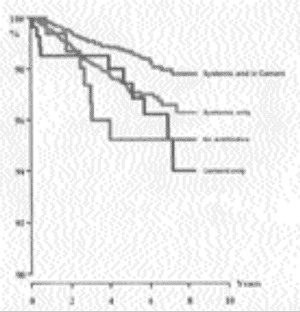
Espehaug et al7 recently examined the use of antibiotic bone cement in primary THRs. They assessed 10,905 primary cemented THRs secured with high viscosity bone cement. Antibiotic bone cement and systemic antibiotics were used in 5804 patients, systemic antibiotics alone in 4586 patients, antibiotic cement alone in 239 patients, and no antibiotics in 276 patients. These investigators have shown that the use of antibiotic bone cement plus systemic antibiotics is the most effective strategy in reducing deep infection. This is followed by the use of systemic antibiotics alone, antibiotic bone cement alone, and no antibiotics (Slide 1).
Swedish Hip Registry
The Swedish Hip Registry has been effective in providing evidence-based decision making for Swedish orthopedic surgeons.8 Not only have cumulative revision rates decreased steadily from 1979 to the present, but there has also been a stepwise reduction in deep infection rates following THR in Sweden (Slide 2).
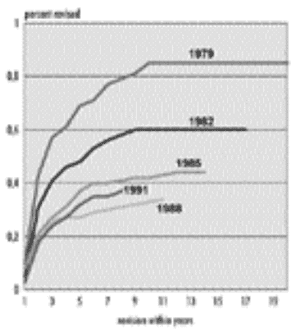
Malchau et al8 examined factors influencing deep infection following cemented THR. They assessed 92,675 primary cemented THRs inserted in Sweden between 1978 and 1990. They concluded that the quality of operating room ventilation and the use of antibiotic-containing bone cement were important factors in reducing deep infection following THR (P=<.001).
Malchau et al8 also performed Poisson modeling, assessing the risk of deep infection in revision surgery using different types of bone cement. Using Sulfix bone cement (Sulzer, Winterhur, Switzerland) as the numerator, these investigators assessed Simplex (Stryker Howmedica Osteonics, Allentown, NJ), CMW (Johnson & Johnson DePuy, Warsaw, Ind), Palacos (Merck/Biomet, Warsaw, Ind), and Palacos Gentamicin (Merck/Biomet) bone cements. They developed a risk ratio for revision using any of these bone cements. Palacos gentamicin bone cement was associated with the lowest risk ratio for revision (Table 1 ).
America, Where Are You?
Convincing evidence is emerging that the use of commercially mixed antibiotic bone cement is effective in reducing deep infection, enhancing implant survival, and improving patient satisfaction following THR and TKR.7-9 These advantages appear to outweigh the risk of drug allergy. Although bacterial drug resistance is always a concern with the use of prophylactic antibiotics, this has not become an important issue in Sweden or Norway. The advantages of antibiotic bone cement seem to outweigh these risks.
Conclusion
Faced with the overwhelming clinical evidence supporting use of antibiotic-laden bone cement in cemented THR and TKR, it seems reasonable for the FDA to reassess their position on this issue. Virtually every orthopedic surgeon in North America uses antibiotic-laden bone cement in the treatment of chronic infections following total joint replacement. It seems logical that prevention of deep infection would be an even better strategy. Drug allergy and drug resistance remain concerns, but they have not emerged as major problems in Scandinavia.
The time for antibiotic-laden bone cement has come. The orthopedic community should stand up for its patients and insist on the use of antibiotic bone cement for joint replacement surgery. There has been ample preclinical testing and overwhelming clinical evidence supporting the use of antibiotic-laden bone cement. If any doubts remain, the FDA should be encouraged to promote post-market surveillance on a large number of patients treated with antibiotic-laden bone cement.
References
- Buchholz HW, Elson RA, Engelbrecht E, Lodenkamper H, Rottger J, Siegel A. Management of deep infection of total hip replacement. J Bone Joint Surg Br. 1981; 63:342-353.
- Carlsson AS, Josefsson G, Lindberg L. Revision with gentamicin-impregnated cement for deep infections in total hip arthroplasties. J Bone Joint Surg Am. 1978; 60:1059-1064.
- Garvin KL, Hanssen AD. Infection after total hip arthroplasty. Past, present, and future. J Bone Joint Surg Am. 1995; 77:1576-1588.
- Trippel SB. Antibiotic-impregnated cement in total joint arthroplasty. J Bone Joint Surg Am. 1986; 68:1297-1302.
- Masri BA, Duncan CP, Beauchamp CP. Long-term elution of antibiotics from bone-cement: an in vivo study using the prosthesis of antibiotic-loaded acrylic cement (PROSTALAC) system. J Arthroplasty. 1998; 13:331-338.
- Younger AS, Duncan CP, Masri BA. Treatment of infection associated with segmental bone loss in the proximal part of the femur in two stages with use of an antibiotic-loaded interval prosthesis. J Bone Joint Surg Am. 1998; 80:60-69.
- Espehaug B, Engesaeter LB, Vollset SE, Havelin LI, Langeland N. Antibiotic prophylaxis in total hip arthroplasty. Review of 10,905 primary cemented total hip replacements reported to the Norwegian arthroplasty register, 1987 to 1995. J Bone Joint Surg Br. 1997; 79:590-595.
- Malchau H, Herberts P, Ahnfelt L. Prognosis of total hip replacement in Sweden. Follow-up of 92,675 operations performed 1978-1990. Acta Orthop Scand. 1993; 64:497-506.
- Josefsson G, Gudmundsson G, Kolmert L, Wijkstrom S. Prophylaxis with systemic antibiotics versus gentamicin bone cement in total hip arthroplasty. A five-year survey of 1688 hips. Clin Orthop. 1990; 253:173-178.