Intermediate to long-term reports of posterior stabilized total knee replacement (TKR) have demonstrated durable results with excellent function at 10- to 15-year follow-up.1,2 In addition, fluoroscopic kinematic studies have demonstrated posterior femoral rollback with knee flexion.3 However, all posterior stabilized TKRs are not alike. They have different cam and post mechanisms. Some cams have an open box and some have a closed box. The tibial posts also are different. Some are positioned more anterior than others and some are taller. Some cam post mechanisms allow for more rotation and some allow for more hyperextension based on the cam post design. Finally, as with different designs of posterior cruciate retaining knees, there are variable amounts of conformity between the femoral and tibial component in different posterior cruciate substituting designs.
The recently reported concern of backside wear associated with modular tibial components in general and the anterior tibial post impingement reported with posterior cruciate substituting designs4,5 have prompted authors to examine the variables contributing to the anterior post wear and osteolysis associated with modular posterior cruciate substituting TKRs.
In our study of 128 Insall-Burstein II modular posterior cruciate substituting TKRs (Zimmer, Warsaw, Ind) followed for a minimum of 5 years, with an average of 6.4 years follow-up, osteolysis was observed around 12% of the implants.6 Femoral components were placed in an average 4° of flexion and tibial components were inserted with an average posterior tibial slope of 3°. The joint line also was evaluated, if necessary, to assure full knee extension and this, in some cases, may have allowed hyperextension of the joint. In the implant retrieval from a case of bilateral knee osteolysis, there was anterior post wear and backside polyethylene wear with evidence of rotational motion at the polyethylene metal tray interface in both knee replacements. The authors have also observed this with other posterior stabilized designs.
These observations, along with the observation that osteolysis and anterior post wear occurs more commonly in bilateral cases, prompted these authors to explore the factors that contribute to impingement of the femoral box on the anterior aspect of the tibial post in posterior stabilized TKR (Slide 1).
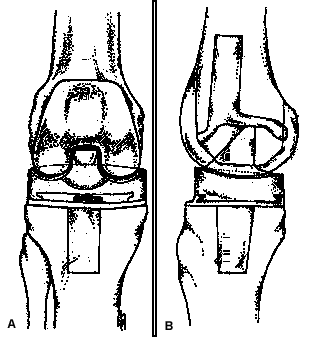
In terms of design, it is important for the components (femoral cam and tibial post) to incorporate some hyperextension before impingement occurs. This is especially important because there is a tendency to place the femoral component in flexion and the tibial component in some posterior slope, which creates overall hyperextension. The design also must allow for some rotation, thus, if post impingement occurs, rotational stress will not be transferred from the post to the underlying modular polyethylene-tibial tray interface, which can generate micromotion and backside polyethylene wear (Slide 2).
In terms of technical details, the surgeon must avoid cutting the proximal tibia in any posterior slope and the distal femur in flexion. In addition, the femoral component should be placed in as much extension as possible. Finally, even with the posterior cruciate substitution designs, creating a large extension gap by elevating the joint line (cutting excessive distal femur) should be avoided. These technical considerations are important in bilateral TKR. These cases are especially at risk for anterior tibial post impingement because of their predisposing anatomy (excessive sagittal plane bowing of the femur leading to flexion of the femoral component) and soft-tissue laxity in some cases. Adhering to these design and technical characteristics should help prevent anterior tibial post impingement and wear in any posterior cruciate substituting TKR.
References
- Aglietti P, Buzzi R, De Felice R, Giron F. The Insall-Burstein total knee replacement in osteoarthritis: A 10-year minimum follow-up. J Arthroplasty. 1999; 14:560-565.
- Colizza WA, Insall JN, Scuderi GR. The posterior stabilized total knee prosthesis. Assessment of polyethylene damage and osteolysis after a ten-year-minimal follow-up. J Bone Joint Surg Am. 1995; 77:1713-1720.
- Stiehl JB, Komistek RD, Cloutier JM, Dennis DA. The cruciate ligaments in total knee arthroplasty: a kinematic analysis of 2 total knee arthroplasties. J Arthroplasty. 2000; 15:545-550.
- Mikulak SA, Mahoney OM, dela Rosa MA, Schmalzried TP. Loosening and osteolysis with the press-fit condylar posterior-cruciate substituting total knee replacement. J Bone Joint Surg Am. 2001; 83:398-403.
- Puloski SK, McCalden RW, MacDonald SJ, Rorabeck CH, Bourne RB. Tibial post wear in posterior stabilized total knee arthroplasty. An unrecognized source of polyethylene debris. J Bone Joint Surg Am. 2001; 83:390-397.
- O’Rourke MR, Callaghan JJ, Goetz DD, Sullivan PM, Johnston RC. Osteolysis associated with a cemented modular posterior-cruciate-substituting total knee design: Five to eight-year follow-up. J Bone Joint Surg Am. 2002; 84:1362-1371.