Introduction
The evolution and selection of femoral fixation in primary total hip arthroplasty (THA) has moved toward biological fixation with immediate stability and ingrowth of the implant. Concerns with the use of cementless fixation include ingrowth, migration, stress shielding, thigh pain, and osteolysis. The choice between a proximal metaphyseal filling cementless stem and a fully-coated diaphyseal fixed implant remains controversial, and currently, surgeons favor both methods of fixation for cementless primary THA.
Proximal Cementless Fixation
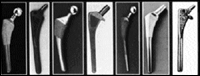
The development of proximal cementless fixation evolved in the early 1980s for use in younger patients with the occurrence of cemented stem failures with early generation cement techniques. Concerns with extensively coated stems and the reported association of stress shielding and thigh pain increased the interest in the development of these proximally fixed stems. This resulted in a large number of proximally fixed stems with a wide variety of geometries and fixation alternatives (Slide 1).
The cobalt chrome alloy Porous Coated Anatomic stem (Howmedica, Rutherford, NJ) was developed first and was associated with granuloma formation and a significant revision rate1 (Slide 2). Similarly, the curved anatomic APR-1 (Intermedics Orthopedics, Austin, Tex) showed a progressive loss in fixation and revision rates,2 especially in the younger, more active patient activity level and with canal fills less than 90%.
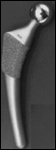
The noncircumferentially coated titanium alloy patch-porous coated straight Harris-Galante stem was associated with significant osteolysis, thigh pain, subsidence, and endosteal erosion.3 The patched porous coating is believed to allow ingress of joint fluid and wear debris into the endosteal canal, increasing the effective joint space.4 Second-generation cementless femoral components were designed to provide more reliable ingrowth and to limit distal osteolysis by incorporating circumferential proximal ingrowth surfaces.
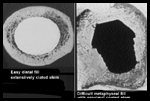
Second-generation tapered stems, which are designed to fill the metaphysis to achieve stability with circumferential porous coating, reduced the incidence of osteolysis and significantly lowered the incidence of femoral revision.5 Excellent clinical and radiographic results have been reported with as high as 100% survival at 10 years.6 However, thigh pain was not eliminated completely with these implants.7 Selection for these implants in some of the reported studies was limited to patients in whom a satisfactory intraoperative fit could be obtained, and many of the proximally coated reports eliminated patients with poor bone quality. The Dorr type A and B femurs are the ideal anatomy for this type of fixation. The difficulty in obtaining proximal fit and fill with these implants led to distal canal fill and fixation in the diaphysis to achieve rotational stability (Slide 3).
Extensively Coated Cementless Fixation
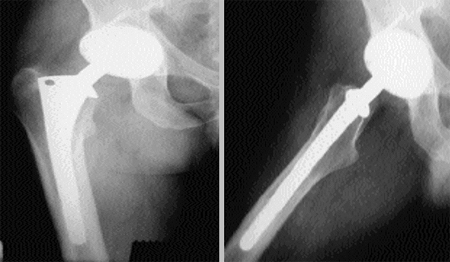
The longest follow-up of extensively porous coated femoral stems has been with the AML prosthesis (DePuy, Warsaw, Ind)—a cobalt chrome nontapered cylindrical stem with a cobalt chrome beaded fixation surface (Slide 4). The preparation of a round diaphyseal canal with reamers to match the cylindrical stem is believed to be an advantage in ease of use of this implant. Proximal metaphyseal bone quality and geometry are less important considerations, and in patients with proximal metaphyseal bone mismatch, this type of implant may be technically easier to insert. By avoiding the tight fit and fill of the metaphyseal bone in the often osteopenic older patients, the risk of metaphyseal fracture is minimized.
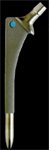
A non-tapered cylindrical stem may provide greater flexibility in adjusting leg length and rotation without compromising fixation when compared to a proximally fixed wedge shaped stem. Femoral revision rates as low as 1.1%8 at minimum 10-year follow-up have demonstrated the long-term durability of this stem in primary THA. Recently reported results demonstrate excellent survivorship (99% at 18 years) overall,9 including younger patients younger than 50 years old for this stem10; however, the revision rates for polyethylene wear in this younger population are higher. In patients older than 65 years, Engh et al8 reported bone ingrowth rates of 98% at 7.5-year follow-up. The high survivorship rates and long-term studies of extensively coated femoral implants are evidence that this mode of fixation is a durable alternative to cement or proximally coated implants (Slide 5).
Design Concerns
Thigh pain
The relation to stem stiffness has traditionally been the explanation for thigh pain. In a study between cementless extensively coated, proximally coated, and cemented femoral implants, there were significant differences in thigh pain.11 Patients with proximally coated stems were more than twice as likely to complain of pain than patients with fully coated or cemented hips (P<.01). Although the incidence of thigh pain was significantly higher with proximally coated stems, the severity was not, averaging 3-3.5 of 10 on visual analog scale in all three groups. The results indicate that patients perceived pain originating in the hip in a high percentage of cases, particularly when proximally coated stems were used.
Stress shielding
The incidence of proximal stress shielding has been reported to be higher in extensively coated implants. This is seen as remodeling of proximal femoral bone, decreased proximal bone density, and thinning of the cortex, especially in the calcar region. Clinically, the most severe stress shielding occurs in extensively porous coated cobalt chrome stems. With the use of dual energy x-ray absorptiometry (DEXA) scanning, the preoperative bone mineral density has been reported as the most significant factor related to periprosthetic bone loss after cementless femoral implantation.12
Previous studies evaluating femoral remodeling after THA have used clinical radiographs and DEXA. Limitations of these techniques make it impossible to quantify the magnitude of bone loss in terms of cortical thinning and cortical bone area and bone mineral density changes.
In a retrieval study,13 a strong correlation was noted between the bone mineral density of the control (nonoperated contralateral) femur and the percentage decrease of bone mineral density in the remodeled operative femur. Based on this data, the less dense the bone is before THA, the greater the extent of bone loss after THA regardless of the fixation type. To date, long-term studies in these extensively coated stems do not show increased failure rate or revisions for stress shielding.
Osteolysis
Previous cementless designs, which incorporated noncircumferential porous coating, have demonstrated an increased incidence of distal osteolysis, occurring beyond the porous coating. However, with the introduction of circumferential coating, proximally and extensively coated implants have an inherent barrier to distal particle migration. With the effective joint space minimized, the greater and lesser trochanter (Gruen zones 1 and 7) may be associated with the development of osteolysis.
Conclusion
Cementless extensively coated stems have been reported to have a 99% stable fixation rate at 18 years.9 The evolution of proximally coated stems with circumferential coating and improved design has added an alternative to extensively coated fixation. Metaphyseal geometry is a significant factor to consider when choosing the type of implant for cementless fixation. Thigh pain and stress shielding have been shown to correlate with preoperative bone quality. Osteolysis of the femur is limited to the lesser and greater trochanter with circumferential coating.
References
- Malchau H, Wang YX, Karrholm J, Herberts P. Scandinavian multicenter porous coated anatomic total hip arthroplasty study. Clinical and radiographic results with 7- to 10-year follow-up evaluation. J Arthroplasty. 1997; 12:133-148.
- Dorr LD, Lewonowski K, Lucero M, Harris M, Wan Z. Failure mechanisms of anatomic porous replacement I cementless total hip replacement. Clin Orthop. 1997; 334:157-167.
- Maloney WJ, Woolson ST. Increasing incidence of femoral osteolysis in association with uncemented Harris-Galante total hip arthroplasty. A follow-up report. J Arthroplasty. 1996; 11:130-134.
- Schmalzried TP, Jasty M, Harris WH. Periprosthetic bone loss in total hip arthroplasty. Polyethylene wear debris and the concept of the effective joint space. J Bone Joint Surg Am. 1992; 74:849-863.
- Bourne RB, Rorabeck CH, Patterson JJ, Guerin J. Tapered titanium cementless total hip replacements: A 10- to 13-year followup study. Clin Orthop. 2001; 393:112-120.
- Archibeck MJ, Berger RA, Jacobs JJ, et al. Second-generation cementless total hip arthroplasty. Eight to eleven-year results. J Bone Joint Surg Am. 2001; 83:1666-1673.
- Hozack WJ, Rothman RH, Eng K, Mesa J. Primary cementless hip arthroplasty with a titanium plasma sprayed prosthesis. Clin Orthop. 1996; 333:217-225.
- Engh CA Jr, Culpepper WJ II, Engh CA. Long-term results of use of the anatomic medullary locking prosthesis in total hip arthroplasty. J Bone Joint Surg Am. 1997; 79:177-184.
- Engh CA Sr, Hopper RH Jr. The odyssey of porous-coated fixation. J Arthroplasty. 2002; 17:102-107.
- Kronick JL, Barba ML, Paprosky WG. Extensively coated femoral components in young patients. Clin Orthop. 1997; 344:263-274.
- Barrack RL, Paprosky W, Butler RA, Palafox A, Szuszczewicz E, Myers L. Patients’ perception of pain after total hip arthroplasty. J Arthroplasty. 2000; 15:590-596.
- Venesmaa PK, Kroger HP, Miettinen HJ, Jurvelin JS, Suomalainen OT, Alhava EM. Monitoring of periprosthetic BMD after uncemented total hip arthroplasty with dual-energy X-ray absorptiometry—a 3-year follow-up study. J Bone Miner Res. 2001; 16:1056-1061.
- Maloney WJ, Sychterz C, Bragdon C, et al. The Otto Aufranc Award. Skeletal response to well fixed femoral components inserted with and without cement. Clin Orthop. 1996; 333:15-26.