Introduction
Hip fractures that fail to heal typically cause marked pain and profound disability. Effective strategies to salvage these difficult problems are important. Treatment of failed hip fractures is divided by fracture location (femoral neck versus intertrochanteric level) and is individualized according to patient age, activity, bone quality, and the status of the joint surface.
Failed Femoral Neck Fractures
Femoral neck fracture nonunions in young patients usually are treated with attempts to salvage the femoral head if the hip joint surface is in satisfactory condition. The most common methods to gain femoral neck union are a Meyers pedicle graft1 and valgus intertrochanteric osteotomy.2 Valgus intertrochanteric osteotomies convert shear forces at the nonunion site to compressive forces and promote fracture healing.
Femoral neck nonunions in older patients commonly are salvaged with conversion to hemiarthroplasty or total hip arthroplasty (THA) (Slide 1).3-6 Hemiarthroplasty is a smaller procedure and has a lower risk of dislocation, but complete pain relief is more reliable with THA. Total hip arthroplasty is preferred when the articular cartilage is badly damaged; otherwise, the decision between hemiarthroplasty and THA is at the surgeon’s discretion.
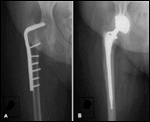
Acetabular bone quality in patients with femoral neck nonunions frequently is poor. When an uncemented cup is used, acetabular fracture or poor press-fit fixation during implant insertion can be problems. The risk can be reduced by avoiding over-reaming of the socket and avoiding overly forceful cup implant impaction and by augmenting cup fixation with screws when necessary.
Failed Intertrochanteric Hip Fractures
Most intertrochanteric hip fracture nonunions in younger patients are treated with nonunion takedown and internal fixation. A blade plate is the preferred fixation device, and autogenous bone grafting also is used.7-9
For older patients with an intertrochanteric nonunion, the surgeon must decide whether to attempt another internal fixation procedure or consider a salvage arthroplasty. The decision is based on patient characteristics, fracture pattern, remaining bone quality, and status of the hip joint surface. In the older patient, arthroplasty has some advantages; fracture fixation does not need to be considered, the biomechanics of the hip can be more readily restored, and the patient can be mobilized quickly.7,10-12
When hip arthroplasty is performed to salvage a failed intertrochanteric fracture, there are specific technical considerations. The surgeon must decide whether to perform THA or a hemiarthroplasty. It is not uncommon to have a cut-out of a compression screw into the acetabular articular cartilage. In this circumstance, and in patients with a markedly arthritic hip, acetabular resurfacing with THA is preferred. Otherwise, the choice is based on patient activity level and hip stability considerations.
Fixation devices on the femur create areas of weakness that can lead to fracture of the femur, particularly with torsion. Preliminary dislocation of the hip once before hardware removal may reduce fracture risk. Broken screws frequently are present; instruments including trephines and screw grasping devices are helpful.
Most patients with a failed intertrochanteric fracture have bone loss to or near the lesser trochanter. The majority need an extended femoral neck implant or a calcar replacement implant to provide leg length and gain hip stability. Long stem implants to bypass screw holes in the femur often are needed.
Successful femoral component fixation can be gained with cemented or uncemented implants. For many older patients cemented fixation is advantageous particularly if the bone quality is poor and canal diameter is large. Cemented femoral fixation allows rapid mobilization. If the stem is cemented, the surgeon needs to be aware that cement can extrude through empty screw holes.13 If an uncemented implant is used, extensively porous coated stems have the advantage of providing fixation in the cylindrical diaphysis of the femur, bypassing the damaged and deficient proximal bone.
Management of the greater trochanter can be problematic. To expose the hip, the surgeon frequently must elevate the nonunited or malunited greater trochanter. A trochanteric slide technique, which keeps the vastus lateralis, greater trochanter, and abductors as a single continuous sleeve of tissue, is preferred.
Bone deformity of the proximal femur, related to fracture callus or malunion, frequently is present and increases the risk of femoral fracture during canal preparation. Shaping sclerotic deformed bone is safer with a power burr or reamers than with a rasp.
Conclusion
In younger patients, salvage of failed hip fractures usually involves hip joint retention, whereas in older patients prosthetic replacement is a good salvage option. When an arthroplasty is the best alternative, attention to specific technical points can improve the success rate and reduce the complication rate for these challenging problems.
References
- Meyers MH, Harvey JP Jr, Moore TM. The muscle pedicle bone graft in the treatment of displaced fractures of the femoral neck: Indications, operative technique, and results. Orthop Clin North Am. 1974; 5:779-792.
- Müller ME, Allgöwer M, Schneider R, Willenegger H. Manual of Internal Fixation. New York, NY: Springer-Verlag; 1979.
- Franzen H, Nilsson LT, Stromqvist B, Johnsson R, Herrlin K. Secondary total hip replacement after fractures of the femoral neck. J Bone Joint Surg Br. 1990; 72:784-787.
- Johnsson R, Bendjelloul H, Ekelund L, Persson BM, Lidgren L. Comparison between hemiarthroplasty and total hip replacement following failure of nailed femoral neck fractures focused on dislocations. Arch Orthop Trauma Surg. 1984; 102:187-190.
- Tabsh I, Waddell JP, Morton J. Total hip arthroplasty for complications of proximal femoral fractures. J Orthop Trauma. 1997; 11:166-169.
- Turner A, Wroblewski BM. Charnley low-friction arthroplasty for the treatment of hips with late complications of femoral neck fractures. Clin Orthop. 1984; 185:126-130.
- Mariani EM, Rand JA. Nonunion of intertrochanteric fractures of the femur following open reduction and internal fixation. Results of second attempts to gain union. Clin Orthop. 1987; 218:81-89.
- Sarathy MP, Madhavan P, Ravichandran KM. Nonunion of intertrochanteric fractures of the femur. Treatment by modified medial displacement and valgus osteotomy. J Bone Joint Surg Br. 1994; 77:90-92.
- Wu CC, Shih CH, Chen WJ, Tai CL. Treatment of cutout of a lag screw of a dynamic hip screw in an intertrochanteric fracture. Arch Orthop Trauma Surg. 1998; 117:193-196.
- Kim YH, Oh JH, Koh YG. Salvage of neglected unstable intertrochanteric fractures with cementless porous-coated hemiarthroplasty. Clin Orthop. 1992; 277:182-187.
- Mehlhoff T, Landon GC, Tullos HS. Total hip arthroplasty following failed internal fixation of hip fractures. Clin Orthop. 1991; 269:32-37.
- Stoffelen D, Haentjens P, Reynders P, Casteleyn PP, Broos P, Opdecam P. Hip arthroplasty for failed internal fixation of intertrochanteric and subtrochanteric fractures in the elderly patient. Acta Orthop Belg. 1994; 60:135-139.
- Patterson BM, Salvati EA, Huo MH. Total hip arthroplasty for complications of intertrochanteric fracture. A technical note. J Bone Joint Surg Am. 1990; 72:776-777.