Introduction
Back pain is the fifth most common cause for a medical visitation. Back pain is benign in most patients; only a select group of patients require further work-up and treatment. Annually, back pain is accountable for more than $20 billion throughout the world.1,2 It is estimated that between 50% to 90% of the population will experience back pain.2-4 Back pain is caused by a multitude of primary and secondary problems. The physician must determine which select group of patients will require further work-up.
Natural History
Although many patients may present with back pain, a comparatively smaller percentage of patients will eventually require further evaluation. Most patients will return to a baseline within 3 weeks, and nearly all patients (more than 90%) by 3 months.5 The majority of patients with back pain will improve with conservative treatment, which includes medication and physical therapy. Patients who present with back pain are often between 45 and 60 years of age. In most patients, a pathological cause for the back pain is never found.
Risk Factors
As in other disease processes, there are risk factors that predispose a patient to back pain. Risk factors for low back pain include increasing age to approximately 55 years, women older than 60 years, smoking, prolonged driving, stress, hard physical labor, and a positive straight leg raise sign.6
Evaluation
When evaluating a patient with back pain, physicians must recognize the multiple organic and nonorganic causes of pain. The types of pain must be categorized as local, referred, radicular, or muscular.7 Local pain is due to involvement of local structures such as the joints, annulus fibrosus, muscle, and ligaments. Referred pain originates from other structures such as the viscera or pelvic structures. Radicular pain stems from compression or irritation of the lumbar roots by a mass or herniated disk.
History
When evaluating a patient, the most important element is the patient’s history. Symptoms can be categorized into three types — acute, subacute, and chronic.1 Acute symptoms present within 6 weeks, subacute symptoms present for 6 to 12 weeks, and chronic back pain lasts for more than 12 weeks. After obtaining the duration of symptoms, a physician may determine the prognosis. Many patients will improve within the first 3 weeks, and almost all patients will improve within 90 days. Patients in the chronic category are the least likely to improve, and they may warrant further investigation.
The next step is to determine which patients need immediate evaluation and which can afford a more conservative approach. Patients presenting with an impending progressive neurological deficit, such as progressive motor deficit or cauda equina symptoms, warrant an expedited work-up. Cauda equina symptoms include progressive lower extremity weakness, saddle anesthesia, bowel/bladder dysfunction, and progressive numbness.
The history must include a general review of systems, including history of cancer, recent weight loss, fevers, or drug use. One must also achieve a sense of precipitating and relieving factors. For example, a history of back and leg pain worsening with coughing or sneezing and alleviated by rest or leg bending suggests a herniated lumbar disk. Back pain improved by rest or supine posture suggests mechanical instability, whereas pain present regardless of posture could be indicative of malignancy or infection. Although the differential diagnosis includes a long list of problems, most will fall into the idiopathic category (Table 1).4
Physical Examination
On physical examination, it is important to perform a thorough evaluation.7 Evaluation includes range of motion, gait, posture, palpation, and neurological examination. Mechanical instability is often worse with flexion, whereas stenosis may be exacerbated by extension. Lateral bending to or away from a herniated disk can irritate the roots depending on the location of the herniation. If the herniation lies lateral to the root, then bending towards the disk will worsen the symptoms. A disk herniation at the axilla will have worsening symptoms away from the affected leg. Tenderness exerted on palpation may be an indication of an inflammatory process or malignancy, but in some cases it may simply be a herniated disk.
Neurological Examination
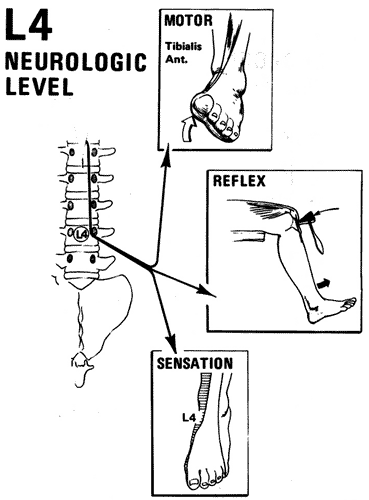
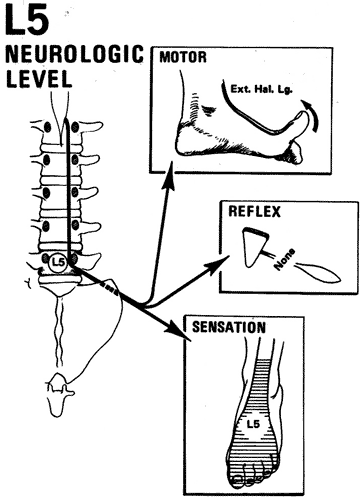
On neurological examination, key elements are attention to any focal weakness, decreased sensation in a particular pattern, and loss or asymmetry of reflexes. The most common herniated disk is L5-S1, followed by L4-L5. In an L5-S1 herniated disk, weakness in plantar flexion and decrease or absent Achilles reflex may be present. In an L4-L5 herniated disk, the physician may notice weakness in the extensor hallucis longus and, to a lesser degree, the Achilles reflex (Slide 1, Slide 2 and Slide 3 ). In cases of lateral disk herniations, physicians encounter symptoms related to the exiting root.
Work-Up
Laboratory tests are seldom required. If a physician is suspicious of infection or malignancy, then a complete cell count, sedimentation rate, and C-reactive protein must be obtained. For more specific suspicion of malignancy, such as prostate cancer or myeloma, physicians should obtain a prostate-specific antigen level and serum electrophoresis.
Evaluation of patients with back pain generally does not require a radiographic work-up. The yield and efficacy of a radiograph are low in patients who have symptoms that were present for less than 3 weeks. Patients with impending symptoms should undergo evaluation sooner. To minimize the economic consequence of low-yield radiography, physicians look for criteria that include a fever higher than 37.8°C and a history of trauma, cancer, and drug use (Table 2).2
While performing the work-up, a physician must be cognizant of psychological and social factors that affect back pain. Patients with secondary gains from being "debilitated" may present with vague symptoms. Similarly, patients undergoing litigation often continue to have persistence of symptoms. In these cases, the Waddell’s test can be performed.3 This test evaluates the possibility of nonorganic causes for back pain (Table 3).
Management of Low Back Pain
Idiopathic low back pain can be managed with little intervention. A study evaluating management guidelines of low back pain showed a consensus in the use of acetaminophen as a first-line drug and nonsteroidal anti-inflammatory drugs (NSAIDs) as a second-line of pain management.8 Others agree with this modality of pharmaceutical use.9 In addition, around the clock administration is recommended, rather than on an as needed basis. There is variability as to when physical therapy should be instituted and less discrepancy in length of bed rest. In the past, prolonged bed rest was recommended. Prolonged bed rest then changed to 2 to 3 days, and more recently, to as early as tolerated activity.10 Some countries advocate physical therapy in the acute period, but in the United States it is recommended by 4 weeks.8
More invasive modalities of intervention such as facet injections, epidural injections, and local anesthetics have produced variable results. In a recent review of randomized trials,11 no conclusive evidence of efficacy has been found. More recently, Foster and colleagues demonstrated improvement in back pain following injections with botulinum toxin A.12
Conclusion
Low back pain affects a large portion of the population at some point. Fortunately, this is a self-limiting problem and improvement occurs in a relatively short period. For many patients, back pain may be treated with acetaminophen or NSAIDs. Bed rest is seldom used. The role of injections remains undetermined.
References
- Bratton RL. Assesment and management of acute low back pain. Am Fam Physician. 1999; 60:2299-2306.
- Patel AT, Ogle AA. Diagnosis and management of acute low back pain. Am Fam Physician. 2000; 61:1779-1786.
- Deyo RA, Weinstein JN. Low back pain. N Eng J Med. 2001; 344:363-370.
- McGregor AH, Hughes SP. Initial assessment of back pain: An overview. Hosp Med. 1998; 59:492-495.
- Andersson GB. Diagnostic considerations in patients with back pain. Phys Med Rehabil Clin N Am. 1998; 9:309-322.
- Loeser JD, Volinn E. Epidemiology of low back pain. Neurosurg Clin N Am. 1991; 2:713-718.
- Adams RD, Victor M. Pain in the Back, Neck and Extremities. Principles of Neurology. New York, NY: McGraw Hill; 2001:204-246.
- Koes BW, van Tulder MW, Ostelo R, Kim Burton A, Waddell G. Clinical guidelines for the management of low back pain in primary care: An international comparison. Spine. 2001; 26:2504-2513.
- Butler SH. Pharmacologic treatment of low back pain. Neurosurg Clin N Am. 1991; 2:891-897.
- Hagen KB, Hilde G, Jamtvedt G. Bed rest is not effective for acute low-back pain or sciatica. Spine. 2000; 25:2932-2939.
- Nelemans PJ, deBie RA, deVet HC, Sturmans F. Injection therapy for subacute and chronic benign low back pain. Spine. 2001; 26:501-515.
- Foster L, Clapp L, Ericson M, Jabbari B. Botulinum toxin A and chronic low back pain: A randomized, double-blind study. Neurology. 2001; 56:1290-1293.