Debris-associated osteolysis is the most common cause for revision total hip arthroplasty (THA) when polyethylene is used. Cross-linked polyethylenes show some promise but raise more questions. New polyethylenes are supported only by laboratory studies and have no clinical data to support their use.
Studies have shown that cross-linked polyethylenes are stiffer and weaker than conventional polyethylene, and wear debris particles generated usually are less than 1 µm (0.1-0.5 µm), the most biologically active particle size.1 Retrievals show that metal femoral heads are typically scratched. Laboratory studies of wear with cross-linked polyethylene against a roughened surface show dramatic increases in wear.2
By contrast, the use of alumina ceramic–ceramic bearings is supported by laboratory and clinical data. In vitro wear studies3 and retrieval studies have consistently shown alumina–alumina bearings have the lowest wear rate of any available bearing. Retrievals have shown that alumina–alumina bearings have 4000 times less linear wear than conventional polyethylene.4 No retrieval data of current cross-linked polyethylene bearings show such dramatically reduced wear. Further, retrievals of alumina bearings show their resistance to scratching from third body particles.5 Scratch resistance is not a feature of cobalt–chromium on cross-linked or conventional polyethylene bearings.
Improvements in density and grain size have increased the strength of the bearings to the point where load to fracture now exceeds 17,000 lbs. This means that liner chipping or wear generally is seen only in cases of recurrent subluxation or dislocation—situations that would require revision in any case.
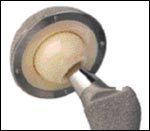
Current designs of alumina–alumina bearings have been used in Europe for more than 14 years and in the United States for more than 5 years. The US patients have been carefully studied as part of Food and Drug Administration investigational device evaluations. The modern versions of alumina–alumina THA feature titanium shells with an internal 18° taper. Some of these acetabular components are designed to accept polyethylene, cobalt–chromium, and alumina bearings interchangeably (Slide 1).
One ongoing US clinical study includes 1223 THAs performed between April 1997 and March 2002 (Transcend and Lineage acetabular components; Wright Medical Technology, Arlington, Tenn). Of these, 446 patients were followed for a minimum of 22 months (mean: 32 months, range: 22-61 months). Average patient age was 53 years. Results show no postoperative bearing fractures and no osteolysis thus far. Reoperations included 1 (0.2%) for deep infection, 2 (0.4%) for recurrent dislocation, 5 (1.1%) for loosening or failure of osseointegration of the femoral component without lysis, 2 (0.4%) for mismatch of the bearing diameter, 1 (0.2%) for malseating of an acetabular liner, and 1 (0.2%) for wear due to repeated subluxation.
These results show that alumina-alumina bearings are reliable at 2 to 5 years in young patients. The data exceed any reports of cross-linked polyethylene in number of patients and length of follow-up. The low incidence of infection is statistically significantly lower than that reported by the Swedish Hip Registry. This may be related to the fact that bacteria typically adhere more strongly to polyethylene than to alumina,6 suggesting that both early and late infection rates may be lower for alumina than polyethylene THA (Slide 2).
In summary, polyethylene wear debris-associated osteolysis is the most significant problem following THA. Alumina ceramic–ceramic bearings have a stronger scientific basis for use than cross-linked polyethylene based on laboratory wear data, retrieval analysis, and clinical studies. Alumina–alumina bearings are a new standard by which all other bearings must be judged.
References
- Endo MM, Barbour PS, Barton DC, et al. Comparative wear and wear debris under three different counterface conditions of crosslinked and non-crosslinked ultra high molecular weight polyethylene. Biomed Mater Eng. 2001; 11:23-35.
- Bowsher JG, Shelton JC. A hip simulator study of the influence of patient activity level on the wear of crosslinked polyethylene under smooth and roughened femoral conditions. Wear. 2001; 250:167-179.
- Clarke IC, Good V, Williams P, et al. Ultra-low wear rates for rigid-on-rigid bearings in total hip replacements. Proc Inst Mech Eng. 2000; 214:331-347.
- Dorlot JM, Christel B, Meunier A. Wear analysis of retrieved alumina heads and sockets of hip prostheses. J Biomed Mater Res. 1989; 23(A3 Suppl):299-310.
- Cooper JR, Dowson D, Fisher J, Jobbins B. Ceramic bearing surfaces in total artificial joints: Resistance to third body wear damage from bone cement particles. J Med Eng Technol. 1991; 15:63-67.
- Oga M, Sugioka Y, Hobgood CD, Gristina AG, Myrvik QN. Surgical biomaterials and differential colonization by Staphylococcus epidermidis. Biomaterials. 1988; 9:285-289.