Amputation in hand fractures is an extreme measure. While digits should not be wantonly amputated, it is a hollow victory to save a stiff, malaligned, painful, dysvascular, cold-sensitive, or insensate digit that obstructs hand function and is a source of constant discomfort to the patient.
Moreover, there may be substantial socioeconomic costs to the patient and society in pursuing a futile reconstruction. These include medical expenses, time and wages lost from work, making the patient a psychological cripple, and rendering him or her unemployable.
It behooves us to be able to identify the severely injured digit(s) that we can repair or reconstruct and those that we can not. A digit that is pain free, aligned, and has adequate sensation and circulation may be worthy of reconstruction or salvage. In these cases, "flexor hinge" digital function may be useful even though classified as "poor" in relation to motion.1-3
Conversely, there are instances when amputation back to the most distal viable and salvageable tissues may be prudent. Brown4 demonstrated excellent hand function in patients with well-performed digital amputations.4 Additionally, modern digital prostheses are often functional as well as cosmetic. Not every patient will wear a prosthesis, but among those who do, many are extremely satisfied.5-7
Irreparable devascularization currently is considered the only absolute indication for immediate or early digital amputation following injury. Yet, stiff, deformed, chronically painful, and severely or chronically infected fingers may require late amputation to restore optimal hand function.
How do we decide which digits cannot be reasonably or adequately salvaged and should be removed early while rehabilitating the hand and the patient within the context of the original injury? Who will benefit from immediate or early digital amputation with this amputation ultimately preserving optimal hand function and implementing optimal, timely, and cost-effective patient recovery? Physical, psychological, and socioeconomic factors must be considered when the surgeon makes his or her assessment, recommendations, and decisions.
Digits have five tissue systems: 1) integument, 2) vasculature, 3) nerves, 4) tendons, and 5) bones and joints. McCormack8 found that concurrent irreparable or segmental damage to three or more of these systems may be a strong indication for initial or early digital amputation in mutilating hand injuries. These criteria have served our patients well. More recent hand injury severity scores tend to confirm McCormack’s classic observations.9,10
Such severe mutilating injuries are frequently contaminated. When contamination is joined by severe tissue damage and poor circulation, infection may be eminent. Such circumstances may further strengthen the indication for amputation. Certainly, if infection occurs early during the course of repair or reconstructive efforts, it may become the prime determinant for amputation.11
A good amputation is a definitive procedure (Slide 1 and Slide 2).12 Amputation is preferable to an interminable effort of salvaging a digit that will be stiff, painful, and nonfunctional, and that interferes with otherwise normal hand function. When two, often adjacent, digits are severely injured and one is salvageable and the other is not, Chase’s "spare parts" surgery may be used to scavenge tissue from the nonsalvageable digit to reconstruct the salvageable digit.13-15
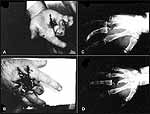
One alternative to amputation when three or more tissues have irreparable damage or segmental injuries is to excise the zone of injury, shorten the digit, and perform a primary repair of all injured tissues.16-18 This is similar to the preparation and repair of tissues performed in post-traumatic revascularizations and replantations. This may be an attractive option when the zone of injury is small or in the thumb.
References
- Strickland JW, Glogovac SV. Digital function following flexor tendon repair in zone II: A comparison of immobilization and controlled passive motion techniques. J Hand Surg. 1980; 5:537-543.
- Gingrass RP, Febring BHT, Matloub H. Interosseous wiring of complex hand fractures. Plast Reconstr Surg. 1980; 66:383-394.
- Duncan RW, Freeland AE, Jabaley ME, Meydrech EF. Open hand fractures: An analysis of the recovery of active motion and of complications. J Hand Surg Am. 1993; 18:387-394.
- Brown PW. Less than 10—surgeons with amputated fingers. J Hand Surg. 1982; 7:31-37.
- Burkhalter WE, Mayfield G, Carmona LS. The upper extremity amputee: Early and immediate post surgical prosthetic fitting. J Bone Joint Surg Am. 1976; 58:46-51.
- Lundborg G, Branemark PI, Rosen B. Osseointegrated thumb prostheses: A concept for fixation of digit prosthetic devices. Am J Hand Surg. 1996; 21:216-221.
- Pereira BP, Kour AK, Leow EL, Pho RWH. Benefits and uses of digital prostheses. J Hand Surg Am. 1996; 21:222-228.
- McCormack RM. Reconstructive surgery and the immediate care of the severely injured hand. Clin Orthop. 1959; 13:75-82.
- Campbell DA, Kay SPJ. The hand injury severity scoring system. J Hand Surg Br. 1996; 21:295-298.
- Roessler MS, Wisner DH, Holcroft JW. The mangled extremity: When to amputate? Arch Surg. 1991; 126:1243-1249.
- Barbieri RA, Freeland AE. Osteomyelitis. Hand Clin. 1998; 14:589-603.
- Steichen JB, Idler RS. Results of central ray resection without bony transposition. J Hand Surg Am. 1986; 11:466-474.
- Chase RA. The damaged index digit—a source of components to restore the crippled hand. J Bone Joint Surg Am. 1968; 50:1152-1160.
- Chase RA. The severely injured upper limb—to amputate or reconstruct: That is the question. Arch Surg. 1970; 100:382-392.
- Alpert BS, Buncke HJ. Mutilating multi-digit injuries: Use of a free micro-vascular flap from a non-replantable part. J Hand Surg. 1978; 3:196-198.
- Axelrod TS, Buchler U. Severe complex injuries to the upper extremity: Revascularization and replantation. J Hand Surg Am. 1991; 16:574-584.
- Meyer VE. Hand amputations proximal but close to the wrist joint: Prime candidates for reattachment (long term functional results). J Hand Surg. 1985; 10:989-991.
- Russell RC, O’Brien BMcC, Morrison WA, Pamamull G, MacLeod A. The late functional results of upper limb revascularization and replantation. J Hand Surg Am. 1984; 9:623-633.