The causes of hallux varus deformity include:
- Excessive soft tissue release
- Fibular sesamoidectomy
- Excessive plication of the medial joint capsule (Slide 1)
- Overcorrection of the first metatarsal osteotomy (Slide 2)
- Trauma to the hallux metatarsophalangeal (MP) joint
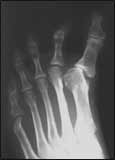
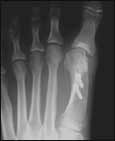
A patient with hallux varus must be evaluated for:
- Range of motion of the hallux MP joint
- Range of motion of the hallux interphalangeal (IP) joint
- Presence of arthritis in the MP or IP joint
- Cock-up deformity of the MP joint (Slide 3)
- Fixed or flexible deformity
- Correctable hallux MP joint
- Effect of the hallux on the lesser toes
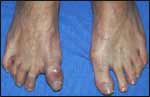
Either a fusion or resection arthroplasty should be performed in patients who have arthritis at the MP joint. If a patient has a fixed deformity of the hallux IP joint, then the only possible correction of the IP joint is an arthrodesis. When an arthrodesis of the IP joint is performed, a simultaneous arthrodesis of the MP joint should not be contemplated due to excessive rigidity of the entire hallux. In patients with a fixed deformity of the hallux IP joint, correction of the IP joint should be performed first followed by a resection arthroplasty of the MP joint.
If there is no stiffness or arthritis of the MP joint, then correction should be obtained without arthrodesis. A tendon transfer is an ideal method to correct the deformity and maintain motion at the MP joint. If the IP joint is fixed in flexion, then an arthrodesis of the IP joint is performed. The extensor hallucis longus (EHL) may be used to obtain correction. When the hallux IP joint is flexible, an arthrodesis of the IP joint should not be performed. Instead, a transfer of the extensor hallucis brevis, as described by Myerson, should be attempted. This procedure preserves the extensor function of the hallux and does not sacrifice a healthy functional tendon.
The extensor hallucis brevis procedure is performed either as a tendon transfer (under the deep transverse metatarsal ligament) or a tenodesis procedure (tendon is transferred to the deep transverse metatarsal ligament and into the first metatarsal). A tenodesis procedure is not a true tendon transfer.
When hallux varus occurs early postoperatively, if the cause is recognized and is not due to overcorrection of the first metatarsal, then the deformity can be corrected by strapping of the hallux into valgus. Permanent valgus deformity does not occur with this treatment method. The strapping should be performed for a minimum of 6 weeks and followed by ambulation in a comfortable shoe that holds the hallux in a corrected position (Slide 4).
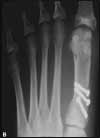
Some patients may develop hallux varus following a fibular sesamoidectomy. In Slide 5, notice the fixed deformity of the hallux IP joint, as well as the uncorrectable deformity of the MP joint. An arthrodesis of the hallux IP joint was performed in this patient in conjunction with a release of the MP joint, including an abductor hallucis release and a resection of the base of the proximal phalanx of the hallux (modified Keller arthroplasty).
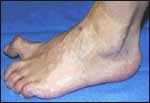
The patient in Slide 6 developed hallux varus following a modified McBride bunion procedure with fibular sesamoidectomy. The MP joint was flexible and the IP joint was fixed, so an arthrodesis of the hallux IP joint was performed in conjunction with a transfer of the extensor hallucis brevis tendon.
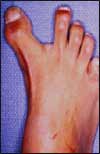
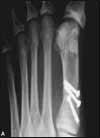
Hallux varus caused by a malunion of a metatarsal osteotomy cannot be adequately corrected with a tendon transfer. The axial alignment of the first metatarsal must be corrected before a tendon transfer will adequately work. The hallux varus shown in Slide 7 was caused by a malunion of the first metatarsal osteotomy. The hallux varus was corrected with a revision of the metatarsal osteotomy using a medial closing wedge to realign the first metatarsal head. In addition to the first metatarsal osteotomy, a transfer of the extensor hallucis brevis was performed to stabilize the MP joint.
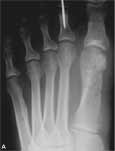
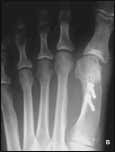
An arthrodesis of the MP joint is the most reliable procedure for correction of an arthritic MP joint if the IP joint remains flexible. Be careful of the position of the lesser toes because an arthrodesis will push the hallux up against the second toe, which may have drifted into varus along with the hallux.