Introduction
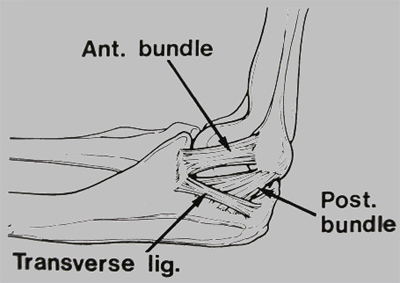
The main stabilizer to valgus stresses applied to the elbow is the medial (or ulnar) collateral ligament. The medial collateral ligament is composed of three parts including the anterior oblique portion, the posterior oblique portion, and the transverse oblique portion (Slide 1).1,2 The anterior oblique portion can be further divided into an anterior band that is under tension from full extension to 85° of flexion, and a posterior band that is under tension from 55° of flexion to full flexion.3 The posterior oblique ligament is under maximum tension in flexion in excess of 60°.3 The anterior oblique portion of the medial collateral ligament is the most important portion in the resistance of valgus stress.4
Overhead athletes, particularly baseball pitchers, are vulnerable to injury of the medial collateral ligament. During the acceleration phase of throwing, peak angular velocities at the elbow have been measured in excess of 4500° per second.5 The forces generated during pitching produce substantial valgus stresses on the elbow that must be resisted by the medial structures, including a static constraint provided by the medial collateral ligament and a dynamic contribution from the flexor-pronator musculature.6 Additionally, the radiohumeral articulation provides a secondary static restraint to these valgus forces.6
Clinical Features
The most common patient complaint is medial side elbow pain with repetitive overhand throwing activities. Sometimes, a patient may recall a distinct injury occasionally with an audible "pop" during throwing (acute ulnar collateral rupture). Another scenario is progressive medial side elbow pain with throwing without distinct recollection of an injury (chronic ulnar collateral injury). Patients with a chronic ulnar collateral injury may also complain of a loss of velocity or control while pitching. A third scenario involves patients with progressive medial side elbow pain that does not necessarily hinder participation in sports, but patients may sustain an acute injury while throwing (acute on chronic ulnar collateral injury). Although the most common mechanism of injury to the medial collateral ligament is throwing, any acute excessive valgus force applied to the elbow in other sports, such as football or wrestling, can disrupt the medial collateral ligament. Additionally, patients may report ulnar nerve paresthesias associated with medial collateral ligament injury.
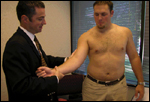
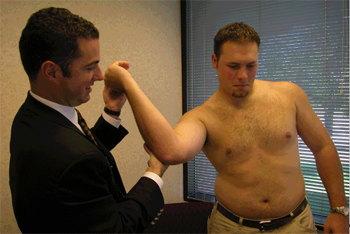
A thorough elbow examination must be performed on any individual with a suspected medial collateral ligament injury. The medial collateral ligament should be palpated for tenderness and the presence of a defect. Valgus force must be applied to a 30°-flexed elbow (to unlock the ulnohumeral joint) in an attempt to detect the presence or absence of an endpoint and to discover if this elicits pain and reproduces the patient’s symptoms (Slide 2). Comparison of relative laxity to valgus stressing with the unaffected extremity should be performed. Alternatively, the O’Brien "milking sign," which may be performed by the patient (Slide 3), can be used to elicit symptoms in the medial collateral ligament deficient elbow. Additionally, signs of ulnar nerve pathology (tenderness, Tinel sign) should be elicited.
Radiographic Findings
Plain radiography is usually normal in patients with a medial collateral ligament injury. Occasionally, calcification is observed within the substance of a chronically injured medial collateral ligament, and, rarely, an avulsion fracture is present at the ligamentous insertion. In contrast to plain radiography, stress radiography performed by applying 150 N of stress to a 25° flexed elbow showing 0.5 mm greater opening when compared to the unaffected extremity is highly suggestive of medial collateral ligament disruption.7
The secondary imaging modality of choice in evaluation of the medial collateral ligament is magnetic resonance imaging (MRI). MRI demonstrates partial and complete tearing of the medial ligamentous structures (Slide 4).
Treatment
Nonoperative treatment, including nonsteroidal anti-inflammatory medications and physical therapy, is the treatment of choice for medial collateral ligament injuries in all nonthrowing athletes. Additionally, in patients with chronic medial collateral ligament injury, a period of rest followed by physical therapy emphasizing strengthening of the flexor-pronator musculature must be attempted.
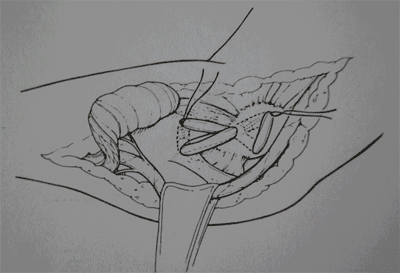
For patients who fail nonoperative treatment, surgical options can be divided into repair of the ligament or ligamentous reconstruction. Often, the remaining medial collateral ligament is attenuated at the time of surgery presumably from repetitive injury. Because of the unhealthy nature of the tissue, reconstruction of the ligament with a free tendon graft has become the procedure of choice for restoration of elbow stability. Autogeneous palmaris tendon is the reconstructive material of choice, but plantaris, Achilles, and long toe extensor grafts have been used with reported success. The reconstruction, initially described by Jobe and colleagues, is depicted in Slide 5. If ulnar neuropathy is clinically present, an ulnar nerve transposition, whether submuscular or subcutaneous, is carried out concomitantly. In Jobe’s series of patients, 80% achieved good or excellent results following medial collateral ligament reconstruction.8
References
- Søjbjerg JO, Ovesen J, Nielsen S. Experimental elbow instability after transaction of the medial collateral ligament. Clin Orthop. 1987; 218:186-190.
- Tullos HS, Schwab G, Bennett JB, Woods GW. Factors influencing elbow instability. Instr Course Lect. 1981; 30:185-199.
- Stroyan M, Wilk KE. The functional anatomy of the elbow complex. J Orthop Sports Phys Ther. 1993; 17:279-288.
- Morrey BF, An KN. Articular and ligamentous contributions to stability of the elbow joint. Am J Sports Med. 1983; 11:315-319.
- Pappas AM, Zawacki RM, Sullivan TJ. Biomechanics of baseball pitching. A preliminary report. Am J Sports Med. 1985; 13:216-222.
- Dehaven KE, Evarts CM. Throwing injuries of the elbow in athletes. Orthop Clin North Am. 1973; 4:801-808.
- Andrews JR, Schemmel SP, Whiteside JA, et al. Evaluation, treatment, and prevention of elbow injuries in throwing athletes. In: Nicholas JA, Herschman EB, Posner MA, eds. The Upper Extremity in Sports Medicine. St Louis, Mo: CV Mosby; 1990:781-826.
- Conway JE, Jobe FW, Glousman RE, Pink M. Medial elbow instability in throwing athletes. Treatment by repair or reconstruction of the ulnar collateral ligament. J Bone Joint Surg Am. 1992; 74:67-83.